Subsidiary vs Branch vs Representative Office: Which Office Setup Should You Choose for Your Singapore Market Entry in 2026?

Updated: Aug 20

Summary
Complete Liability Protection: A Singapore subsidiary establishes an independent legal entity, ensuring that the financial risks of local operations do not affect the foreign parent company's balance sheet.
Parent Company Exposure: Establishing a branch office leaves the foreign parent entity fully liable for all debts and legal actions faced by the Singapore branch, as they are considered a single legal body.
Strict Commercial Limits: A representative office serves only as a temporary, non-revenue-generating option for basic market research, requiring a transition to a permanent structure within three years.
As a foreign business, expanding your operations into Singapore requires clear structural decisions. This begins with choosing the right office structure for your foreign business in Singapore.
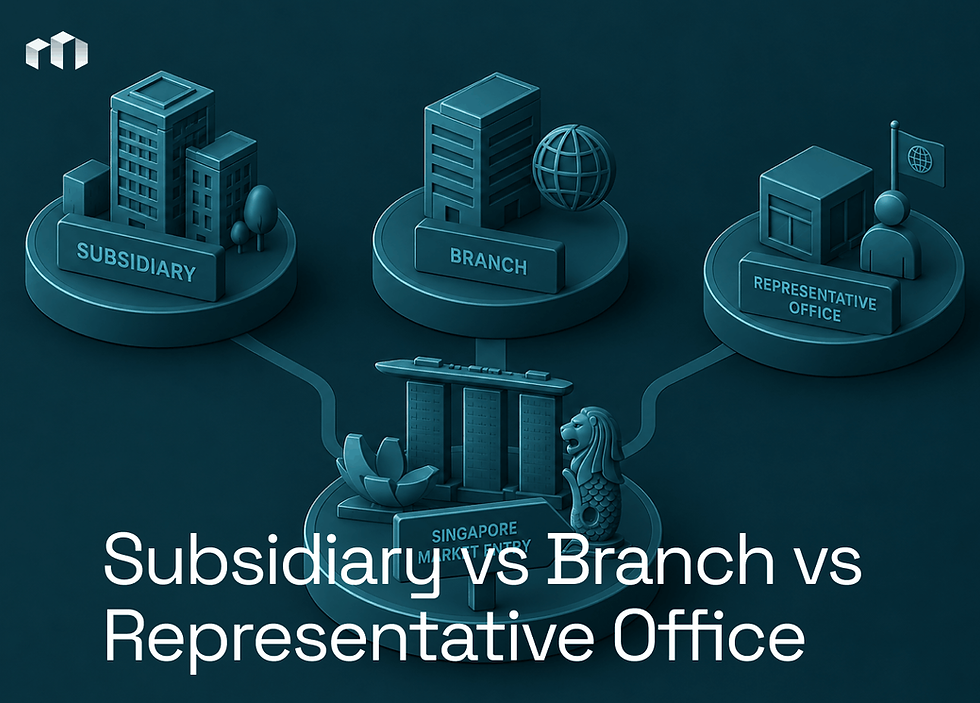
The Accounting and Corporate Regulatory Authority (ACRA) provides three setup options for you to establish your presence in Singapore:
Subsidiary
Branch
Representative office
Each of these setups operates on a different set of corporate tax liabilities and legal boundaries. Choosing the wrong setup creates unnecessary compliance risks, tax exposures, and administrative costs.
By working with a corporate service provider like Mezzanine Enterprise, you protect your foreign parent entity from local operational liabilities and build a compliant foundation for regional growth in Singapore.
In this article, we break down the practical realities of the three primary corporate setups, helping you choose the right path for your international expansion.
Subsidiary vs Branch vs Representative Office: A Structural Comparison
Let's start with a side-by-side comparison of Subsidiary vs Branch vs Representative Office. The table below highlights their key differences across five core parameters of corporate governance:
Parameter | Subsidiary Company (Pte Ltd) | Branch Office | Representative Office (RO) |
Legal Entity | Separate, independent legal entity | Direct administrative extension of the foreign parent company | Non-legal administrative entity |
Liability | Limited strictly to the paid-up capital of the subsidiary; parent assets are protected | Unlimited; the foreign parent company carries full legal exposure | Unlimited; any local liabilities flow directly to the parent entity |
Primary Activity | Full trading capabilities, commercial sales, contract execution, and local fundraising. | Full trading capabilities via the parent’s credit history and corporate identity. | Limited strictly to market research, liaison work, and brand promotion. |
Taxation | Taxed as a resident entity at a flat 17% corporate rate, qualifying for localised exemptions. | Taxed as a non-resident entity at a flat 17% rate; generally excluded from startup exemptions. | Tax-neutral; zero tax exposure as it is strictly prohibited from earning revenue. |
Filing Requirements | Annual Returns with ACRA (including localised accounts); Corporate Income Tax returns with IRAS. | Annual Return lodgement with ACRA comprising both branch and parent financial audits. | Annual renewal application and operational review filed with Enterprise Singapore. |
With this comparison in mind, let's now define what each office setup is and what they entail.
What is a Subsidiary in Singapore?
A subsidiary is a private limited (Pte Ltd) company incorporated in Singapore where the majority or whole shareholding is held by a foreign corporate entity. This setup is the most popular choice for international businesses expanding into Southeast Asia.
The primary advantage of a subsidiary is its status as a distinct legal entity that completely separates it from its foreign parent firm. This means the liabilities, debts, and legal obligations incurred by your Singapore office will not cross borders to threaten the assets of your main corporate headquarters.
Furthermore, a subsidiary qualifies for local tax rebates. Although the standard corporate tax rate is a flat 17%, a subsidiary can access the Partial Tax Exemption (PTE) framework. Under this framework, you enjoy a 75% tax exemption on your first S$10,000 of normal chargeable income, and a 50% exemption on the next S$190,000.
To maintain this structure, your subsidiary must follow standard corporate governance rules. This begins with appointing a local corporate secretary within six months of registration, and also appointing at least one ordinary resident director who lives in Singapore. You can easily fulfil both requirements with Mezzanine Enterprise’s professional corporate services:
What is a Branch Office?
A branch office operates as a direct commercial extension of your foreign parent company. Unlike a subsidiary, it is not a separate legal entity. Under Singapore common law, the branch and the foreign parent company are considered a single legal entity.
This structural choice creates significant risk for your business. As there is no legal separation between your two entities, any commercial default, lease breach, or legal action against your Singapore branch leaves your foreign parent company completely exposed. Creditors in Singapore have full legal authority to target the assets of your home entity to settle local debts.
The tax treatment for branches is also more complicated. A branch office is generally treated as a non-resident entity by the Inland Revenue Authority of Singapore (IRAS). This status means that you will not qualify for local tax incentives and tax treaties reserved for resident firms.
Administratively, registering a branch requires you to appoint at least one local resident agent, who will receive official notices and legal documents on behalf of your company. The branch must also submit the audited financial statements of the foreign parent company alongside its own local accounts to ACRA every year. This requirement often raises privacy concerns for international brands.
What is a Representative Office?
Finally, we have the representative office (RO), which is a temporary administrative setup designed solely for market exploration. Enterprise Singapore handles the registration of ROs, limiting their lifespan to a maximum of three years.
As a transient entity, an RO cannot engage in any form of commercial activity, trade, or revenue generation. Although it is simple to set up due to not requiring a local resident director or agent, an RO’s inability to conduct business means it only delays the inevitable need for a true corporate framework.
The RO model is strictly limited to promotional activities, market analysis, and product research. If your staff attempt to sign contracts, issue invoices, or trade goods through an RO, your business will be deemed to have violated ACRA regulations. This exposure leads to structural penalties and sudden tax audits.
Before the RO window closes, you are required to either close the office or upgrade the structure into a permanent setup like a subsidiary or a branch.
Incorporate Your Singapore Entity with Mezzanine Enterprise
Choosing between these office structures requires expert guidance. Mezzanine Enterprise provides a professional, human-led corporate governance infrastructure backed by a full-service law firm to guide your expansion.
We replace rigid automated ticketing systems with direct access to local experts who protect your business from compliance risks. We also manage your resident director and corporate secretary appointment obligations with our professional services.
Build your corporate expansion on a secure foundation. Reach out to Mezzanine Enterprise today to establish your Singapore presence with full compliance from Day One.
Frequently Asked Questions
Can our foreign parent company own 100% of the Singapore subsidiary?
Yes. Singapore's business-friendly regulatory framework allows foreign corporations to hold 100% of the equity in a local subsidiary. There are no requirements to surrender shares to local partners or form joint ventures. Additionally, Singapore imposes zero capital controls, enabling your subsidiary to freely repatriate tax-exempt dividends back to your foreign headquarters without restriction.
Does a Singapore subsidiary qualify for the Start-Up Tax Exemption (SUTE)?
No. The Start-Up Tax Exemption (SUTE) scheme is strictly available to newly incorporated companies where all shareholders are individuals (with at least one individual holding a minimum 10% stake).
As your subsidiary is wholly or majority-owned by a foreign corporate entity, it does not meet this criterion. However, your subsidiary does automatically qualify for the Partial Tax Exemption (PTE), which lowers your effective tax rate by exempting 75% of your first S$10,000 of normal chargeable income, and 50% of your next S$190,000.
What are the financial disclosure rules for a branch office compared to a subsidiary?
A branch office faces strict disclosure rules. It must lodge its own local financial accounts alongside the fully audited financial statements of the foreign parent company with ACRA every year. This makes your global finances public record. A subsidiary only needs to file the financial reports of the local Singapore corporation, keeping your global balance sheets completely private.
How does tax residency change the corporate tax burden for a branch office in Singapore?
IRAS generally views a branch office as a non-resident entity. This status means it cannot access local tax deduction schemes or certain double taxation treaties. A subsidiary is treated as a local tax resident, allowing it to use the Partial Tax Exemption (PTE) framework to reduce its actual tax bill well below the standard 17% rate.
Do we need to hire a local director if we decide to open a Singapore subsidiary?
Yes. Section 145 of the Companies Act mandates that every private limited company must appoint at least one ordinary resident director who lives in Singapore. If your executive team lives overseas, you can hire a professional nominee director through an ACRA-registered corporate service provider like Mezzanine Enterprise to meet this statutory rule.