Outsourced vs In-House Corporate Secretary: Which is Better for Scaling SMEs in Singapore?


Summary
The Costs Add Up: Hiring a dedicated in-house corporate secretary in 2026 carries a high financial overhead (often exceeding S$50,000 to S$100,000 annually in base salary and benefits), whereas an integrated managed model delivers enterprise-grade advisory at a fraction of the cost.
Outsourced Proactive Governance: Outsourcing your corporate shifts, director changes, and share capital restructuring to an external corporate service provider (CSP) backed by legal infrastructure completely shields scaling small and medium enterprises (SMEs) from compliance bottlenecks, penalty exposures, and single-point-of-failure operational risks.
The Legal Baseline: Regardless of which option you choose, board resolutions and change logs serve as the absolute baseline for all major strategic shifts. Structural flaws or formatting errors can potentially expose you to severe legal and operational vulnerabilities.
The corporate governance ecosystem in Singapore has fundamentally shifted, particularly in the wake of the full rollout of the Corporate Service Providers Act (CSP Act) and the Accounting and Corporate Regulatory Authority (ACRA)’s heightened compliance enforcement.
Whether you’re a fast-growing startup, scaling mid-tier enterprise, or multinational subsidiary, corporate compliance has become especially important, transforming from a passive back-office routine into a highly strategic risk-management function.
In this regulatory climate, you’re faced with a critical structural crossroad: Should you form your own internal compliance department, or should you outsource to an integrated, managed corporate secretarial provider (CSP)?
In this article, we compare the outsourced vs in-house corporate secretary models, demonstrating why outsourcing your corporate secretarial function to a dedicated external CSP is the best choice to protect your business’s structural integrity, eliminate single-point-of-failure liabilities, and optimise your compliance expenses.
The Strategic Importance of a Corporate Secretary
Before we jump into comparing in-house and external corporate secretaries, let’s first run a quick primer on why they are so important for your company.
More than simple data entry administrators, corporate secretaries single-handedly manage your company’s entire paper trail, ensuring every corporate alteration recorded on public registries is backed by clear corporate resolutions, boardroom minutes, and statutory registers.
Under the Singapore Companies Act 1967, board resolutions provide the ultimate legal baseline for every strategic shift within a company. Whether your board seeks a consensus on a commercial credit facility, executes a share allotment, or alters directorship panels, your corporate secretary is in charge of meticulously documenting the entire corporate action end-to-end.
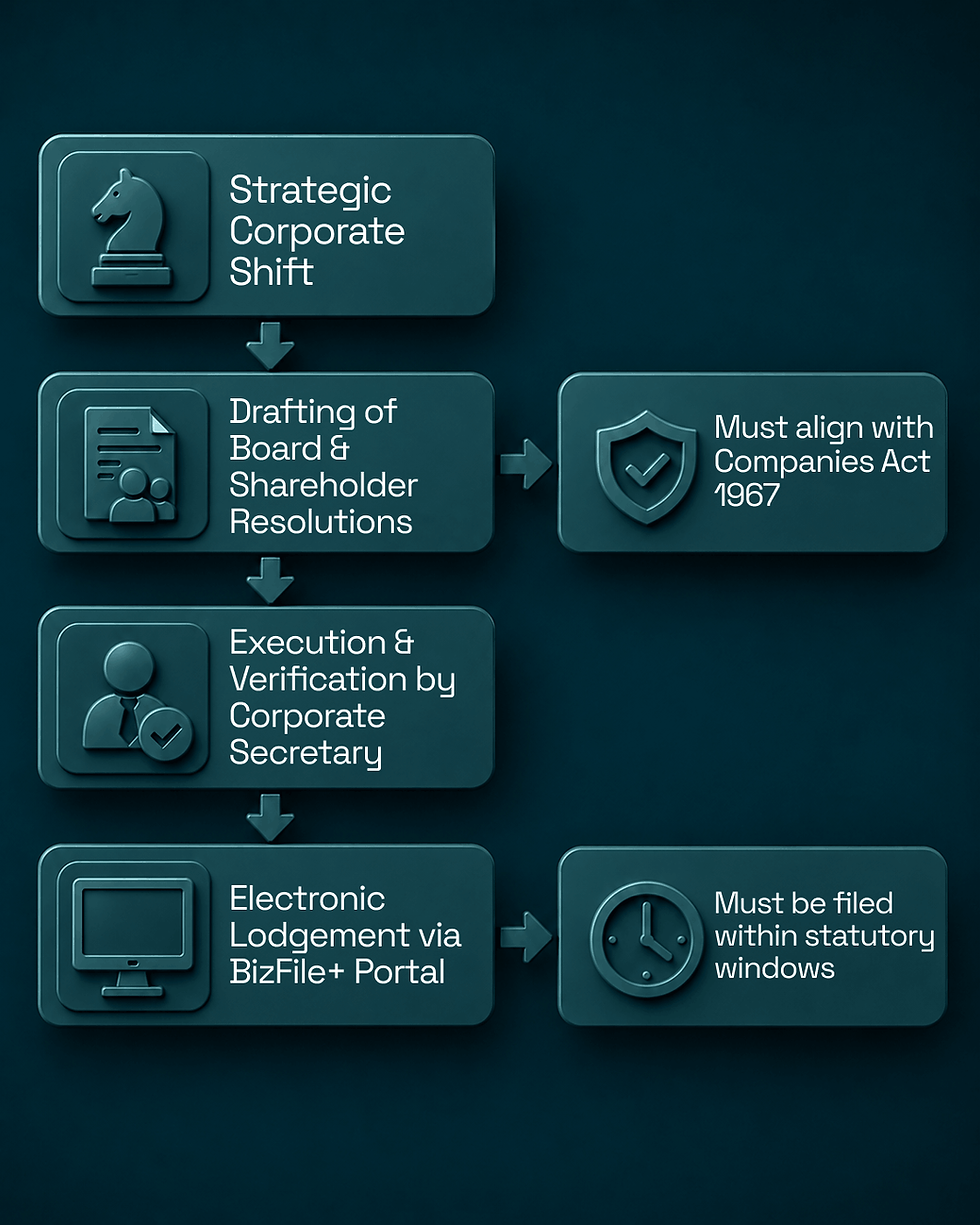
Improperly formatted or delayed minutes create systemic legal vulnerabilities that will negatively impact sensitive yet crucial corporate actions, such as institutional venture capital due diligence rounds, buy-side mergers and acquisitions (M&A) valuations, or rigorous audits by the Inland Revenue Authority of Singapore (IRAS).
If an investor’s legal team uncovers gaps in your historical share transfer records or identifies resolutions passed without a valid quorum, your funding runway will be affected.
You can easily circumvent this risk by engaging a professional corporate secretary, who serves as a proactive gatekeeper for the corporate governance framework to adapt to all legislative updates while maintaining a clear audit trail.
The key question now is this: Should you go in-house, or should you outsource to an external managed CSP?
Outsourced Corporate Secretary: Managed Institutional Scalability
By contrast, partnering with an external managed corporate secretarial provider (CSP) like Mezzanine Enterprise replaces the individual dependence of the in-house model with a robust, multidisciplinary institutional infrastructure.
Instead of relying on a single person, this model connects your business directly to a structured team of qualified corporate secretaries, corporate governance experts, and legal advisors.
1. Elimination of Operational Sickness & Turnover Gaps
With a managed CSP, your compliance tracking operates on an institutional level, maintaining a continuous presence. If a specific account manager is unavailable, a qualified substitute steps in with full visibility into your historical corporate records, ensuring your corporate resolutions are drafted, validated, and lodged well ahead of any statutory deadline.
2. Dynamic Multi-Disciplinary Expertise
When your business encounters a non-standard corporate shift, such as setting up a complex employee share option plan (ESOP), restructuring your founder’s equity, or aligning an international subsidiary, you do not need to hire outside legal consultants.
A managed CSP like Mezzanine Enterprise houses corporate service experts, tax strategists, and corporate legal generalists under one roof, providing end-to-end guidance for your business.
3. Cost Optimisation & Transparent Scaling
A managed CSP model converts rigid, expensive fixed staff overhead into a predictable, modular variable cost. This means that your secretarial spend is adjusted to suit your needs; in times of low corporate transactional activity, your secretarial spend remains low.
Conversely, when your business undergoes rapid expansion, fundraising rounds or structural changes, your managed CSP partner adjusts your secretarial spend accordingly to account for the increased workload. This all happens without needing you to directly recruit, onboard, and pay for new permanent staff.
In-House Corporate Secretary: Dedication vs. Single-Point-of-Failure Risk
To help you answer this question, let’s first examine the argument for hiring your own in-house corporate secretary.
Doing so immediately offers you one distinct advantage: complete institutional alignment. An internal professional understands your operational nuances, is immediately available for internal executive discussions, and focuses exclusively on your corporate portfolio.
However, for small-to-medium enterprises (SMEs) and mid-market companies, the operational risks and financial burdens of an entirely internal setup are substantial, as highlighted below:
1. Specialisation Deficit
Corporate governance does not occur in isolation. A professional qualified to handle basic ACRA filings may lack the legal acumen required to draft complex shareholder agreements, structure multi-tier international subsidiaries, or navigate the complex cross-border tax considerations of an inbound market entry.
Conversely, hiring a senior legal counsel to manage routine corporate secretarial filings is an inefficient use of highly paid human capital.
2. Single-Point-of-Failure Risk
Relying on a single internal employee to manage your company's entire compliance architecture introduces massive operational risk. If your in-house secretary goes on medical leave, transitions out of the company, or falls behind on the compliance calendar, your company’s statutory filing machinery effectively stops.
In an age where missing an ACRA statutory timeline triggers immediate composition fines and direct director enforcement actions, a single internal bottleneck can lead to severe personal liabilities for your board.
3. Expensive Overheads
An in-house employee represents a fixed, permanent operational expense that scales independently of your actual business transaction volumes. Beyond their base salary, your company must also pay employer Central Provident Fund (CPF) contributions, corporate healthcare plans, performance bonuses, continuous professional training fees, and the physical overhead of dedicated office space and software licenses.
Outsourced vs In-House Corporate Secretary: A Financial Comparison
To fully evaluate the cost efficiency of your corporate governance strategy, you must look past simple upfront pricing and analyse the total financial impact.
The table below compares the economics of building an in-house compliance department against Mezzanine Enterprise’s integrated corporate secretarial model:
Cost & Risk Category | Outsourced Corporate Secretary (Mezzanine Enterprise) | In-House Corporate Secretary |
Retainer / Basic Salary (Annual) | S$480 – S$1,800 (Predictable, multi-tiered compliance packages tailored to operational scale) | S$48,000 – S$84,000 (Based on a monthly salary of S$4,000 to S$7,000 for a qualified executive) |
Statutory Add-ons & Benefits | S$0 (Completely absorbed within the professional service delivery agreement) | S$8,160 – S$14,280 (17% Employer CPF match, comprehensive health coverage, and allowances) |
Operational Continuity Risk | Zero (Institutional team redundancy guarantees continuous coverage 365 days a year) | High (Single-point-of-failure risk from resignations, medical leave, or sudden staff turnover) |
Scope of Expert Capabilities | Comprehensive (Integrated ecosystem of corporate secretaries, tax professionals, and legal specialists) | Restricted (Limited to the individual employee’s specific historical experience) |
Software & Infrastructure Fees | S$0 (Fully integrated corporate tech stack provided as part of the service platform) | S$1,500 – S$3,000 (Dedicated corporate secretarial management software, secure storage, and training) |
Total Annual Cost Estimate | S$480 – S$1,800 (Reflects massive, clear bottom-line savings across your operational budget) | S$57,660 – S$101,280+ |
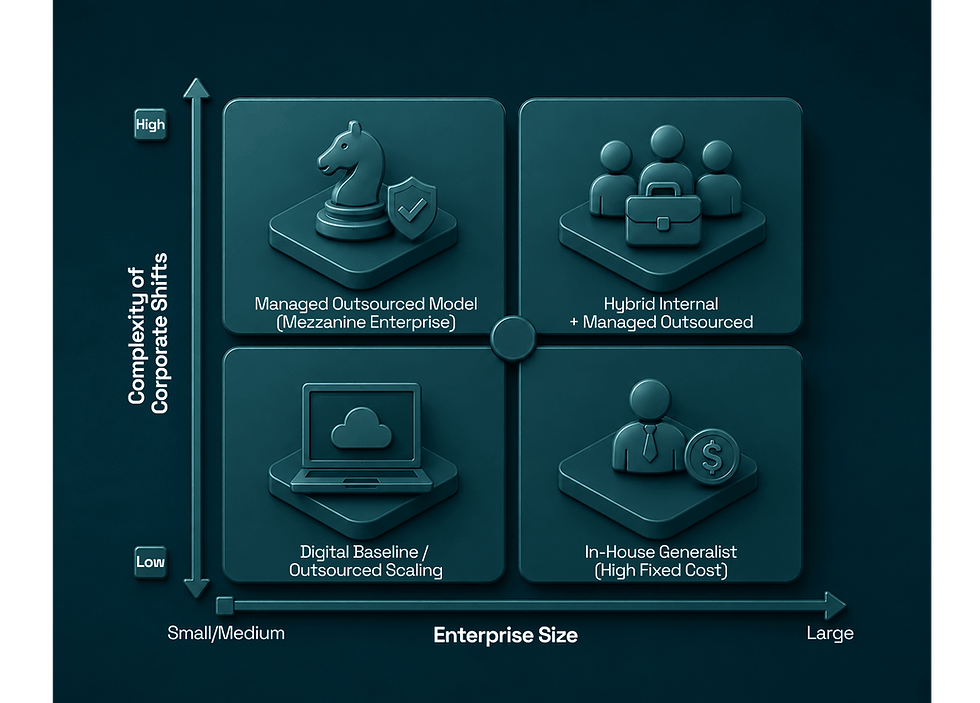
Operational Cost-Risk Matrix: Choosing Your Compliance Pathway
To guide your executive decision-making process, consider this operational framework mapping business size and transaction complexity against the ideal governance model:
For Early-Stage Launchpad & Lean Startups
Building an internal compliance team is financially impractical. Digital platforms can manage baseline filings, but they often lack the deep human advisory needed to protect your business as it begins to scale.
For Fast-Growing Mid-Market Enterprises & Scaling SMEs
This is where the managed model provides the highest return on investment. It delivers the comprehensive protection and expertise of a multi-disciplinary compliance department without the heavy cost burden of an in-house team.
For Large Corporations
While an in-house general counsel may be necessary to oversee day-to-day internal contracts, large corporations still outsource the specialised corporate secretarial engine to a managed partner to eliminate administrative bottlenecks and manage variable transaction volumes.
Protect and Scale Your Enterprise Governance with Mezzanine Enterprise
Navigating the complexities of modern corporate changes while keeping pace with Singapore's strict regulatory frameworks requires professional oversight. Relying on disjointed internal spreadsheets or hands-off digital service portals can expose your board to severe compliance liabilities and technical filing errors.
Mezzanine Enterprise provides an expert, human-led corporate governance infrastructure backed by a full-service law firm. We replace impersonal chatbots and rigid automated systems with direct access to highly qualified, Singapore-based corporate legal and financial experts.
Whether your company is restructuring its share capital, managing complex corporate board adjustments, or preparing its books for a major institutional fundraising round, our professional solutions are designed to fully safeguard your commercial entity:
Flawless Resolution Architecture: We meticulously draft, review, and organise your corporate minutes and board resolutions to ensure your corporate governance stands up to the strictest institutional audits.
Rapid Change Execution: We handle immediate updates to your company profile, director panels, share capital allocations, and registered office addresses with absolute precision and zero operational delay.
Seamless Back-Office Integration: We tie your corporate secretarial tracking directly into professional, SFRS-compliant bookkeeping and tax strategies, building a secure, comprehensive foundation for your business.
Don't let compliance bottlenecks or administrative overhead slow down your company's growth. Contact our expert team today to transition to a modern corporate governance framework.
Frequently Asked Questions
Is it cheaper to outsource my corporate secretary or hire one in-house?
For most SMEs, outsourcing is cheaper. A qualified in-house corporate secretary in Singapore typically costs between S$57,660 and S$101,280+ per year once you factor in base salary, 17% employer CPF, health coverage, bonuses, training, and secretarial software. An outsourced managed provider like Mezzanine Enterprise offers tiered packages from as little as S$480 to S$1,800 annually, converting a high fixed cost into a predictable, scalable one.
What happens to my compliance if my in-house corporate secretary resigns or goes on leave?
This is the single biggest risk of the in-house model, often called single-point-of-failure risk. If your sole internal secretary leaves, falls ill, or slips behind on the compliance calendar, your statutory filing machinery effectively stops. This may lead to you missing your ACRA deadlines, which can trigger composition fines and direct enforcement action against your directors. A managed provider removes this exposure entirely, because an institutional team maintains continuous coverage; if one account manager is unavailable, another steps in with full visibility into your records.
Can an outsourced corporate secretary handle complex work like share restructuring or an ESOP?
Yes, and this is often where outsourcing pulls ahead. A single in-house hire may be perfectly capable of routine ACRA filings but lack the legal depth to draft complex shareholder agreements, structure an employee share option plan (ESOP), restructure founder equity, or align an international subsidiary. A managed provider houses corporate secretaries, tax professionals, and legal specialists under one roof, so you get end-to-end guidance on non-standard corporate actions without separately engaging outside legal counsel.
Are there situations where an in-house corporate secretary still makes sense?
For large corporations with high transaction volumes and a full internal legal function, an in-house general counsel can be useful for overseeing day-to-day internal contracts. Even then, most large companies still outsource the specialised corporate secretarial engine to a managed partner to absorb administrative bottlenecks and handle variable transaction loads. For lean startups and scaling SMEs, building an internal compliance team is generally financially impractical, and the managed model delivers the highest return on investment.
Why do properly documented board resolutions and minutes matter so much?
Under the Singapore Companies Act 1967, board resolutions are the legal baseline for every major strategic action: credit facilities, share allotments, director changes, and more. Improperly formatted or delayed minutes create systemic legal vulnerabilities that surface at the worst possible moments: venture capital due diligence, M&A valuations, or an IRAS audit. If an investor's legal team finds gaps in your share transfer history or resolutions passed without a valid quorum, it can stall your funding. A professional corporate secretary acts as a proactive gatekeeper, keeping a clean, audit-ready trail.