Grant Advisory vs DIY Application in Singapore: Which Route is Right for Your Business?


Summary
Grant advisors deliver value through strategic positioning and error prevention: For complex, high-value, or bespoke projects, a grant advisor bridges the gap between your business strategy and agency evaluation criteria, catching compliance errors and preventing costly processing freezes or rejections.
DIY is best for simple applications or repeatable schemes: Handling grant applications in-house works well for straightforward equipment or software adoptions, especially when your internal team has prior experience with the specific grant scheme.
Project complexity dictates the right choice: Factors like multi-category funding, custom capability upgrades, and difficult-to-quantify business outcomes require a professional grant advisor, whose fees are a cost-effective investment relative to the operational risks of a delay.
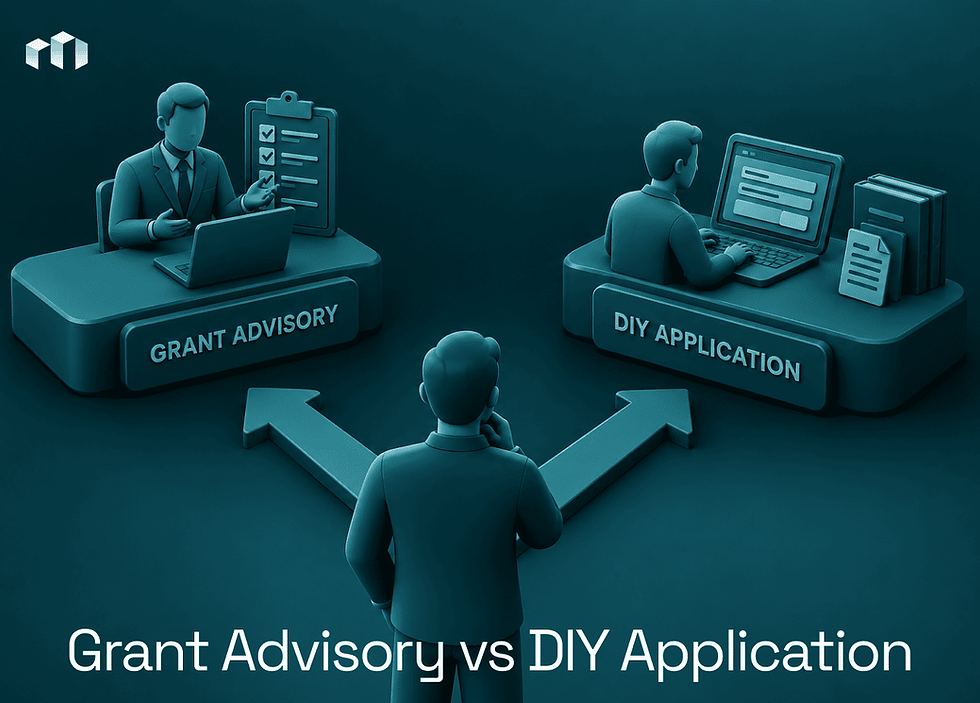
When applying for business grants in Singapore, your business generally faces a crossroads: manage the application internally (DIY) or hire a professional grant advisor.
Deciding which route to take requires balancing the upfront cost of an advisor against the time, internal resources, and strategic framing required to secure approval.
For some businesses, handling the paperwork internally is a straightforward way to save money. For others, an under-resourced DIY application introduces costly delays and compliance risks that eclipse any saved consultancy fees.
In this article, we compare the grant advisory vs DIY approaches in Singapore, showing you how to evaluate your project’s complexity and what to look for when choosing a professional partner like Mezzanine Enterprise.
The DIY Route: Weighing Cost Savings Against Internal Bandwidth
Handling a grant application in-house is often the most economical choice for simple, low-stakes applications. If your business is adopting a straightforward, pre-approved IT solution or equipment where the scope and eligibility are clearly defined by the grant agency, the DIY path is highly effective.
The DIY approach also makes sense when a founder or internal project manager already knows the scheme inside out. If your internal team has successfully secured similar grants in the past, their prior experience further narrows the knowledge gap a consultant would otherwise close.
However, the DIY route can introduce massive hidden costs if the project goes beyond basic adoption. If your internal team vaguely defines your project outcomes, misaligns your project scope, or overlooks a corporate compliance gap, your application will be flagged and disapproved.
The weeks lost scrambling to answer clarification requests, revise documents, and resubmit your application can severely disrupt your project timeline. While this lost time doesn't technically translate to an invoice, it still represents a real financial cost to your business operations.
The Grant Advisory Route: Hiring Expert Help for Complex Projects
By contrast, an external grant advisor has a vested interest in framing your project with precision to increase your grant success. Rather than simply filling out forms, they help your business build a strong proposal that clearly connects your funding request to measurable capability gaps and long-term growth metrics.
For complex, high-value projects, the calculation flips heavily in favour of a grant advisor. This is especially true for projects that deal with bespoke strategic consulting, overseas market expansion, or heavy automation.
Your grant advisor meticulously ensures your project milestones match the grant agency's mandates, catching avoidable rejection triggers such as:
Incomplete documentation
Misaligned cost categories
Unclear scope
Ultimately, a grant advisor minimises the time investment required from your C-suite, allowing your team to focus on running the business rather than parsing through complex government grant frameworks and evaluation algorithms.
Grant Advisory vs DIY Application in Singapore: Make the Right Choice Based on Cost & Project Complexity
To decide between an external grant advisor or going DIY, you must accurately judge your project's complexity. Structure creates more complexity than total grant size. A highly complex project typically involves:
A Blended Funding Mix: Projects that span multiple cost categories simultaneously (e.g., overhauling internal business strategy while heavily investing in bespoke software development).
Strategic Capability Upgrades: Initiatives involving deep brand development, innovation, or process redesign that lack pre-approved vendor lists and require highly customised proposals.
Unclear Connections to Growth: Scenarios where it is difficult to articulate exactly how the requested funding will directly lead to measurable financial or operational outcomes.
Consider this scenario as an example: Two businesses apply for the same S$100,000 strategic digitalisation project.
The first engages a grant advisor, who helps them build a proposal that is well-structured and passes without friction. The second business goes DIY to save the fee but submits a weak outcome justification. The agency requests multiple clarifications, adding weeks to the timeline.
While both may eventually get funded, the second business loses weeks of operational momentum and internal labour hours that far exceed the true cost of the grant advisor's fee.
Spotting Red Flags and Choosing Your Application Path
If you determine that your project's complexity warrants a professional grant advisor, you must vet their methodology and track record. Ask for examples of similar past projects and look out for these specific red flags before signing an engagement letter:
Approval Guarantees: Look twice at any grant advisor who guarantees approval. All applications are ultimately subject to the rigorous evaluation of the governing agency, entirely free from the influence of any external consultant.
Contingent Fees: Be wary of fee structures that are entirely contingent on a successful outcome. This setup often incentivises grant advisors to overstate your project's deliverables or rush the application rather than presenting a highly accurate, compliant business case.
Ignoring Baseline Compliance: Avoid grant advisors who push straight to drafting without first auditing your fundamental corporate compliance. Outdated corporate records or unfiled Annual Returns will trigger automatic rejections regardless of how well the proposal is written.
Get Expert Advisory on Your Grant Applications with Mezzanine Enterprise
At Mezzanine Enterprise, our team of expert grant advisors avoid these red flags in our approach to your business' application process. While we cannot guarantee 100% approval through the proposals we guide you on, we operate on two key principles: transparency and commitment to excellence.
We rigorously evaluate your project scope against current agency criteria to give you a transparent recommendation. Whether your project is simple enough for an internal team or complex enough to demand professional intervention, we believe it deserves a clear assessment before you commit your resources. If the DIY route is the better, more cost-effective fit for your specific application, we will tell you plainly.
Chat with us to find out whether your next grant application needs a consultant, and what level of support suits your business goals.
Frequently Asked Questions
How do I decide whether to apply for a business grant myself or hire a grant advisor?
Base your decision on your project's complexity and your internal bandwidth. If your application involves straightforward adoption and your team has the time and experience, DIY is usually the most economical choice. If your project involves custom strategic transformations, multiple cost categories, or high funding amounts, engaging a grant advisor offers better security and efficiency.
What makes a grant application "complex" enough to justify hiring an advisor?
Complexity is driven by project structure rather than grant size alone. An application becomes highly complex when it combines multiple funding schemes or cost categories, requires bespoke proposals for non-standard capability upgrades (like custom R&D or international expansion), or lacks straightforward metrics connecting the project to clear business outcomes.
What are the hidden costs of taking the DIY route for a complex grant?
While DIY avoids upfront consultancy fees, the hidden costs manifest as lost time, internal labour, and operational delays. Incomplete documentation or poorly defined outcome justifications frequently lead to agency clarification requests, resubmissions, or outright rejections. The weeks or months lost during processing freezes can stall critical projects and cost far more than a consultant's fee.
Can a grant advisor guarantee that my application will be approved?
No. Any advisor who guarantees approval is a major red flag. Grant approvals are strictly determined by the governing government agency based on project merit, compliance, and alignment with evaluation criteria. A legitimate grant advisor strengthens your application, ensures regulatory compliance, and optimises project framing, but cannot influence the agency's final decision.
What red flags should I watch out for when vetting a grant consultant?
Be cautious of consultants who guarantee grant approval, offer fee structures that depend entirely on approval, push straight to signing without first auditing your corporate compliance (like ACRA and Annual Return filings), or lead with generic pitch decks before understanding your specific project scope and capability gaps.
