Cap Table for Singapore Startups: Founder's Equity and Share Vesting Explained (2026 Guide)


Summary
Distinct Ownership Views: Your official ACRA BizFile+ ledger records issued shares and legal members, whereas a capitalisation table (cap table) tracks fully diluted ownership, including option pools (ESOPs) and unconverted debt instruments.
Statutory Authority Matters: Under Section 161 of the Companies Act 1967, directors cannot issue new shares without explicit shareholder authorisation. Share allotments inject growth capital into the business, whereas share transfers merely shuffle existing ownership between individuals.
Protective Equity Safeguards: Implementing four-year vesting schedules with one-year cliffs and maintaining pristine corporate secretarial documentation neutralises dead-weight equity risks, protecting your cap table for institutional VC due diligence.
Launching a venture in Singapore offers local and foreign businesses unparalleled access to global capital, legal transparency, and business-friendly tax frameworks. Yet, as founders come together to transform early ideas into scalable commercial realities, they often overlook the legal mechanics of equity structuring.
Equity is the most valuable currency a startup has at its disposal. Allocating it prematurely without structured vesting, failing to maintain an accurate capitalisation table (cap table), or confusing the legal mechanics of share issuance can cause severe governance gridlock.
At incorporation, co-founders frequently opt for an even 50/50 or 33/33/33 split under the assumption that equal effort means equal legal ownership. However, static equity splits rarely reflect the long-term realities of venture building, where technical commitments, capital contributions, and operational roles evolve unevenly over time.
Navigating share capitalisation in Singapore thus requires a firm grasp of both commercial negotiations and the Singapore Companies Act 1967.
In this article, we break down the core elements of cap tables for startups in Singapore, exploring the mechanics of founder equity allocation, share allotments versus transfers, and vesting structures to keep your venture investor-ready from Day One.
What is a Cap Table? The Mechanics of Cap Table Architecture for Singapore Startups
A cap table is the primary operational ledger used to track who owns what in your enterprise. While early-stage founders often manage this on a basic spreadsheet, a professional cap table must accurately reflect two distinct states of ownership:
Issued Share Capital: Represents actual shares issued and registered with the Accounting and Corporate Regulatory Authority (ACRA). These carry immediate voting rights, dividend entitlements, and statutory standing under the Companies Act 1967.
Fully Diluted Equity: Represents total potential ownership assuming all convertible notes, Simple Agreements for Future Equity (SAFEs), and Employee Share Option Plans (ESOPs) are fully exercised or converted.

The Common Pitfall: ACRA Profile vs. Cap Table
A common mistake among first-time founders is treating their ACRA BizFile+ business profile as their cap table. Take note that ACRA only keeps records of issued share capital and legal members, and does not display unallocated Employee Stock Ownership Plan (ESOP) pools, unexercised employee options, or unissued conversion rights attached to debt instruments.
Relying solely on your ACRA profile leads to calculation errors when negotiating term sheets. Investors calculate their target ownership percentage against the fully diluted denominator.
To illustrate, if you negotiate a 15% investment round based on issued shares while ignoring an existing 10% ESOP pool and an unconverted SAFE, you will experience dilution when these convertible instruments convert.
Share Allotment vs. Share Transfer: How Startup Capital Scales
As your business scales and requires fresh operational capital or equity redistribution, you must alter your share structure. Under Singapore law, equity expansion occurs through two distinct legal pathways: Share Allotment and Share Transfer:
Dimension | Share Allotment | Share Transfer |
Primary Definition | Creation and issuance of brand-new shares by the company. | Reassignment of existing issued shares from one holder to another. |
Source of Equity | Company treasury / fresh share issuance. | Current shareholder's personal holdings. |
Destination of Funds | Direct injection into the company’s corporate bank account. | Paid directly to the selling shareholder as personal consideration. |
Total Share Count | Increases overall share volume, diluting existing holders. | Total issued share count remains unchanged. |
Statutory Requirement | Section 161 shareholder resolution + ACRA Return of Allotment. | Instrument of Transfer, Board Approval, and Stamp Duty Payment to IRAS. |
Executing a Share Allotment Under Section 161
When raising capital from angel investors or venture capital funds, your primary mechanism is share allotment. As issuing new shares dilutes the voting power and economic interest of existing members, the Companies Act strictly regulates this process.
Under Section 161 of the Companies Act 1967, directors cannot issue new shares without prior authorisation from shareholders. This approval is granted via an Ordinary Resolution (passed by a simple majority exceeding 50% of voting rights) at an Annual General Meeting (AGM) or Extraordinary General Meeting (EGM).
Once shareholder consent is secured and investment capital is deposited into the company’s bank account, your corporate secretary must file a Return of Allotment on ACRA’s BizFile+ platform within 14 days. The share allotment is legally complete only when ACRA updates its central register and issues the updated Electronic Certificate of Shares.
Executing a Share Transfer and Managing Stamp Duty
Conversely, a share transfer involves shifting ownership of existing shares. This occurs when an early founder exits, a co-founder buys out a partner, or an early investor sells secondary shares. Unlike share allotments, share transfers do not generate cash for the company's operating account. Financially, cash flows directly from the buyer to the seller.
Legally, a share transfer in Singapore requires four steps:
Board Review and Approval: The board evaluates the transfer while reviewing pre-emption rights outlined in the Constitution or Shareholders’ Agreement.
Execution of Legal Documents: The transferor and transferee execute an Instrument of Transfer alongside a formal Written Resolution of Directors.
IRAS Ad Valorem Stamp Duty Assessment: Share transfers are subject to stamp duty administered by the Inland Revenue Authority of Singapore (IRAS). Stamp duty is calculated at 0.2% of the higher of the purchase price or the net asset value (NAV) of the transferred shares.
ACRA Notification: The corporate secretary submits the notice of transfer on BizFile+. The update takes legal effect upon updating ACRA's Register of Members.
Share Vesting Schedules and ESOP Pool Architecture
Unvested equity poses a significant structural risk to early-stage businesses.
Picture this scenario: three co-founders incorporate a Singapore company with an equal 33.3% shareholding each. Six months post-incorporation, one founder leaves to pursue another opportunity.
Without equity vesting safeguards, the departing founder retains a third of the company's equity permanently. This creates deadweight equity on your cap table, causing the business to become uninvestable in future institutional venture rounds.
Structuring Founder Vesting and Reverse Vesting
To guard against equity loss, co-founders must implement a Share Vesting Agreement or Reverse Vesting Mechanism. Under a reverse vesting agreement, founders receive their full share allocations upfront to exercise immediate voting rights. However, these shares are subject to a contractual clawback or repurchase right held by the company.
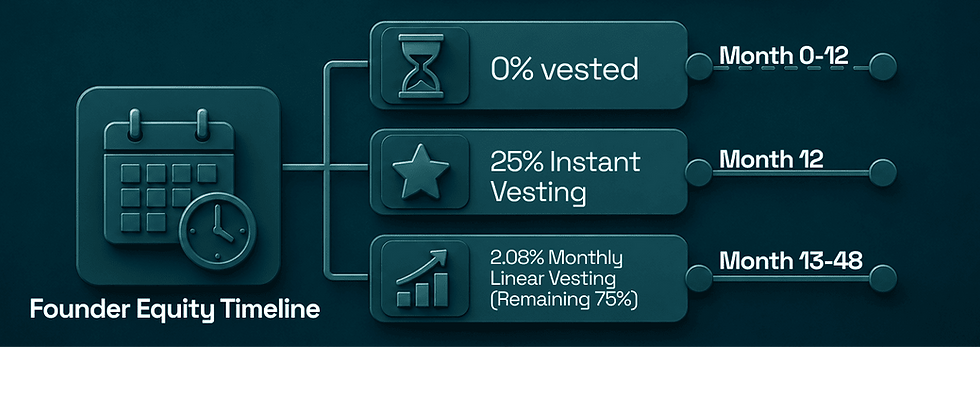
The standard benchmark across Singapore’s venture ecosystem is a four-year vesting schedule paired with a one-year cliff:
The One-Year Cliff: During the first 12 months, zero equity vests. If a founder leaves prior to completing 12 months of service, the company exercises its right to buy back all unvested shares at a nominal price (e.g., S$1.00 total).
Linear Vesting: Upon reaching the 12-month mark, 25% of the founder’s equity vests immediately. The remaining 75% vests incrementally on a monthly or quarterly basis over the subsequent 36 months.
Designing an Employee Share Option Plan (ESOP)
To attract and retain top-tier executive talent, growing startups use Employee Share Option Plans (ESOPs). An ESOP grants eligible team members the contractual right, but not the obligation, to purchase company shares at a fixed price (the Exercise or Strike Price) after meeting specified vesting conditions.
Key components of an ESOP structure include:
Option Pool Sizing: Startups typically reserve 10% to 15% of their fully diluted share capital for an ESOP pool. Investors usually insist on creating or topping up this option pool before a priced investment round, ensuring existing shareholders absorb option dilution rather than the incoming investor.
Taxation Rules Under IRAS: According to the Income Tax Act, ESOPs are not taxed upon grant. Tax liability only arises when gains or profits arise from the ESOP. IRAS taxes the spread, calculated as the difference between the fair market value of the shares at exercise and the exercise price paid, as taxable employment income.
Maintaining Governance Alignment for Institutional Due Diligence
As your corporate structure expands across equity rounds, maintaining clean compliance records is critical. Institutional investors review statutory records during due diligence rounds, and unresolved administrative discrepancies can disrupt funding timelines.
To ensure your cap table withstands rigorous institutional scrutiny:
Maintain Statutory Registers: Ensure your Register of Members, Register of Directors, and Register of Registrable Controllers (RORC) are accurately maintained and synchronised with ACRA BizFile+.
Verify Constitution Provisions: Review your company's Constitution for pre-emption rights, drag-along provisions, and tag-along rights before issuing new instruments.
Document Shareholder Approvals: Ensure every historical share allotment is backed by valid Section 161 shareholder resolutions and properly executed board minutes.
Build a Resilient Corporate Architecture with Mezzanine Enterprise
Managing cap tables, executing statutory share allotments, and structuring IRAS-compliant ESOP frameworks require specialised governance expertise. Fragmented corporate secretarial services and low-cost offshore providers often miss critical nuances, leaving founders exposed to ACRA penalties, defective share issuances, and costly legal remediations during fundraising.
Mezzanine Enterprise delivers a law-firm-backed corporate secretarial and financial governance infrastructure designed for scaling companies. Our experienced local compliance specialists and legal partners ensure your corporate actions, from simple director changes to complex equity top-ups, comply fully with all relevant laws.
Protect your startup's core assets, simplify equity management, and ensure continuous statutory compliance.
Frequently Asked Questions
What is the difference between an ACRA BizFile+ record and a startup cap table?
An ACRA BizFile+ business profile is Singapore's public statutory record, listing issued share capital and registered legal members. However, a startup capitalisation table (cap table) tracks fully diluted ownership, incorporating unissued Employee Share Option Plans (ESOPs), convertible debt (SAFEs/CAREs), and unvested founder shares.
While ACRA reflects current legal ownership, investors evaluate a startup's equity structure using the fully diluted cap table to calculate true dilution and share pricing during investment rounds.
What legal steps are required under Section 161 to issue new shares in Singapore?
Under Section 161 of the Singapore Companies Act 1967, directors cannot issue shares without prior shareholder approval.
To execute a valid allotment:
Shareholders must pass an Ordinary Resolution approving the share issue.
The Board of Directors must formally approve the subscription and capital receipt.
The company’s corporate secretary must lodge a Return of Allotment on ACRA BizFile+ within 14 days.
Issuing shares without Section 161 authorisation invalidates the allotment and exposes directors to statutory liability.
How does a four-year share vesting schedule with a one-year cliff operate?
A four-year vesting schedule with a one-year cliff ensures equity is earned over time through sustained service:
The One-Year Cliff: No equity vests during the first 12 months. If a founder or employee departs within this period, they forfeit all equity rights.
Cliff Reaching (Month 12): On the first anniversary, 25% of total granted equity vests immediately.
Post-Cliff Linear Vesting (Months 13–48): The remaining 75% vests incrementally every month (2.08% per month) across the next three years.
This structure protects companies from dead-weight equity if early personnel depart prematurely.
How is stamp duty calculated and paid on share transfers in Singapore?
Share transfers involve reassigning existing shares between parties and are subject to ad valorem stamp duty managed by the Inland Revenue Authority of Singapore (IRAS).
Tax Rate: Stamp duty is levied at 0.2% of either the purchase consideration or the net asset value (NAV) of the transferred shares, whichever is higher.
Filing Timeline: Stamp duty must be paid within 14 days of executing the Instrument of Transfer within Singapore, or within 30 days if executed overseas.
Completion: ACRA will not complete the update on the public Register of Members until IRAS issues the official Stamp Duty Certificate.
How are Employee Share Option Plans (ESOPs) taxed for employees in Singapore?
In Singapore, granting an option under an ESOP is not a taxable event. The Inland Revenue Authority of Singapore (IRAS) taxes equity benefits at the time of option exercise.
Taxable Income: The taxable gain is classified as employment income and calculated as:
{Taxable Gain} ={Market Value of Shares at Exercise} - {Exercise Price Paid}
Exemptions: Unlisted private companies can explore qualifying equity remuneration schemes (such as the Qualified Employee Equity-Based Remuneration Scheme) to defer tax payments on exercised shares for up to five years, subject to IRAS approval conditions.


